Licenca
To delo je na voljo pod pogoji slovenske licence Creative Commons 2.5:

priznanje avtorstva - nekomercialno - deljenje pod enakimi pogoji.

Celotna licenca je na voljo na spletu na naslovu http://creativecommons.org/licenses/by-nc-sa/2.5/si/. V skladu s to licenco je dovoljeno vsakemu uporabniku delo razmnoževati, distribuirati, javno priobčevati, dajati v najem in tudi predelovati, vendar samo v nekomercialne namene in ob pogoju, da navede avtorja oziroma avtorje in izdajatelja tega dela. Če uporabnik delo predela, kar pomeni, da ga spremeni, preoblikuje, prevede ali uporabi to delo v svojem delu, lahko predelavo dela ponudi na voljo le pod pogoji, ki so enaki pogojem iz te licence oziroma pod enako licenco.

Navodila

Read the text about a famous woman scientist and mark whether the given sentences are true (T), false (F) or not given (NG). Prevod


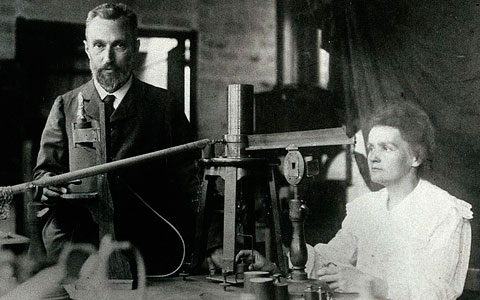
Marie Curie was a physicist and a chemist best known for her work on radioactivity. She was born Maria Sklodowska to Polish parents at a time when Poland was under Russian rule. When Marie was a child it was against the law to send girls to school, so her parents, who were both teachers, sent her to a secret school called the Floating University. Then she attended a gymnasium for girls, from which she graduated with flying colours.
Marie Curie studied in Paris, where she obtained a degree in maths and physics. There she met her future husband, who was one of the professors at the University of Paris. After finishing her studies, she wanted to teach at Krakow University but she was denied a post because she was a woman. She returned to Paris and married Pierre Curie.
Marie Curie and her husband worked together to investigate radioactive minerals. She discovered that radioactivity came from the atoms of materials. She also discovered the radioactive elements of thorium, polonium and radium. When her husband died she continued his work as a professor at the University of Paris and thus became the first woman to teach at the university.
Unfortunately, this famous female scientist wasn't aware of the harmful effects of radioactive materials. Marie Curie carried out experiments without any safety measures. She often carried radioactive testing material in her pockets. Because of her long-term exposure to radiation, she died of leukaemia.
Marie Curie was the first woman to win the Nobel Prize in physics in 1903 for her researches into radiation. In 1911 she won the Nobel Prize in chemistry for her contribution to the advancement of chemistry through the discovery of radium and polonium. Marie Curie was known for her honesty and generosity. She gave most of her Nobel Prize money to relatives, friends, students and researchers. Marie Curie believed that the money from her awards should be given to the scientific institutions at which she worked.

<NAZAJ
>NAPREJ233/315